Why test data breaks automation
Alongside timing and synchronisation issues, the classic root causes of unstable tests (Luo et al., FSE 2014), there is an often-overlooked driver: deterministic tests running against non-deterministic data. Shared environments mutate under you: another team books the account your test expected, a nightly job archives the order you meant to cancel. And the classic shortcut, copying production, is mostly off the table: personal data in test systems violates the GDPR unless it's properly anonymised.
Five principles
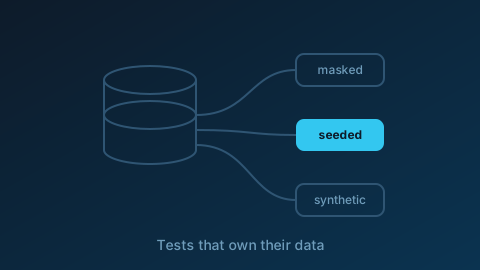
- Tests own their data. The most reliable pattern: each test creates (or requests) what it needs, be it an account, an order or a posting, and doesn't depend on leftovers. In our SAP migration work we seeded data through the application with Tosca for exactly this reason.
- Classify before you tool. Static reference data (countries, tax codes) can be shared forever; consumable data (an order you cancel) must be created per run; stateful master data (a customer with history) needs a refresh strategy. Each class gets a different mechanism.
- Mask, don't copy. Where production-like data is genuinely needed, use masking/anonymisation so no real person is identifiable, and document it; that's your GDPR position.
- Subset, don't clone. A referentially consistent 2 percent slice loads in minutes, refreshes nightly and covers most functional testing better than a terabyte clone that's always stale.
- Synthesise the edge cases. The customer with 40 accounts, the leap-year birthday, the umlaut-heavy name: synthetic generation produces what production can't legally give you and chance rarely does.
Five steps to start
- 1. Inventory: take your 20 most important automated tests and write down what data each actually needs. The list is always shorter, and messier, than expected.
- 2. Classify each item: reference / consumable / stateful.
- 3. Decide per class: shared read-only set, create-on-demand, or masked subset with refresh.
- 4. Automate provisioning in the pipeline: data setup is part of the test run, not a manual pre-step on a wiki page.
- 5. Measure: track your false-failure rate before and after. That number is how you sell the effort to management.
Our take
Test data management isn't a tool purchase; it's a design decision per data class, and it pays back in trust: a suite that only fails when something is broken. Tools help execute the decision (Tosca brings solid test-data facilities; open-source stacks combine generators and masking libraries), but the classification comes first. Want an honest read on where your automation loses trust? A QA Health Check looks at exactly this. Or start a conversation.